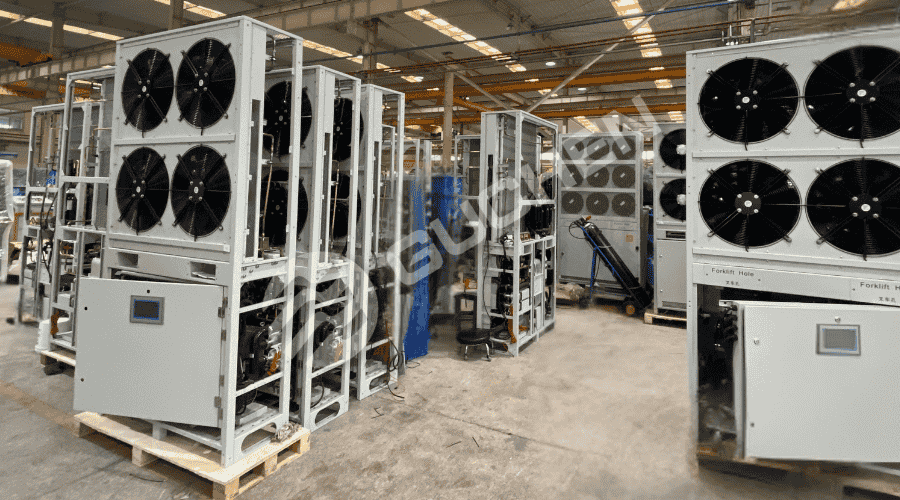
As energy storage systems continue to develop rapidly, maintaining battery cells within an ideal temperature range has become essential for system safety and efficiency. Especially with the increasing scale of deployment and the normalization of extreme climates, traditional air-cooling methods are gradually showing limitations, while liquid-cooling solutions are increasingly prominent in medium and large energy storage scenarios.
In this issue, we will help you systematically understand the working principles, performance comparison, applicable scenarios, and selection strategies of the two thermal management technologies, providing professional references for your
energy storage projects.
I. Working Principle Comparison: Basic Architectures of Air Cooling and Liquid Cooling
1.Air Cooling System
Air cooling transfers heat from the battery cell surface to the outside through forced air convection driven by fans.
Typical components include:
- Fans (blowing/exhaust)
- Thermal controllers
- Heat dissipation channel design (usually integrated with the BMS)
Its advantages are simple structure, low cost, and easy maintenance. However, heat exchange efficiency is limited, making it difficult to maintain uniform temperature control under high energy density or large ambient temperature differences.
2.Liquid Cooling System
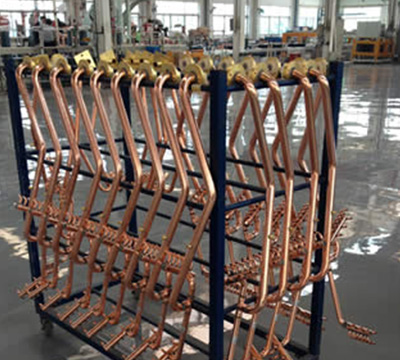
Liquid cooling uses coolant circulating through cooling pipelines to carry heat away from the cell area, then releases it outside the system via heat exchangers or chillers.
Typical components include:
- Coolant/heat transfer fluid (commonly water–ethylene glycol mixtures)
- Cold plates or immersion-type conductive structures
- Liquid pumps/circulation pumps
- Heat exchangers (condensers, water chillers, etc.)
- Control system (sensors + intelligent thermal management logic)
Liquid cooling offers high thermal conductivity, precise temperature control, and small temperature differences, maintaining a battery pack temperature difference <3°C. It is especially suitable for high-rate charging/discharging and high-stress environments.
II. Performance Comparison: Key Indicators Overview
| Indicator |
Air Cooling System |
Liquid Cooling System |
| Heat Dissipation Efficiency |
Medium |
High |
| System Complexity |
Low |
High |
| Initial Investment Cost |
Low |
Medium ~ High |
| Operating Noise |
Higher (fan noise) |
Low |
| Temperature Control Accuracy |
±5°C |
±2°C, can reach ±1°C |
| Space Occupation |
Small |
Medium |
| Routine Maintenance Difficulty |
Low |
Medium |
| Environmental Temperature Adaptability |
Average |
Excellent |
| Overall Safety |
Medium |
High (better thermal diffusion suppression) |
III. Typical Application Scenarios
✔ Air Cooling Suitable Scenarios:
- Residential energy storage systems (household 5–20 kWh)
- Small to medium C&I energy storage (<100 kWh)
- Temperate regions with small temperature fluctuations
- Systems with low precision requirements for cooling
- Projects with tight initial budgets
✔ Liquid Cooling Suitable Scenarios:
- Ground-mounted centralized energy storage stations (>250 kWh)
- Large C&I energy storage clusters (≥100 kWh)
- Data center backup power systems
- Extreme climate regions (hot climates like the Middle East, cold climates like Northern Europe)
- Projects requiring high levels of lifespan, safety, and efficiency
IV. Economic Analysis of Liquid Cooling vs Air Cooling
Although the initial investment for liquid cooling is slightly higher—about 1.3–1.8× that of air cooling—liquid cooling demonstrates greater economic advantages from a lifecycle cost (LCC) perspective:
- Battery cell lifespan can be extended by 15–20%
- System operating efficiency improves by 5–10%
- Supports higher charge/discharge rates, increasing energy output value
- Stronger safety performance reduces system failure/thermal runaway risks
Especially in energy storage scenarios with large peak–valley electricity price differences and frequent system cycling, liquid cooling solutions often achieve cost recovery within 3–5 years, delivering higher ROI.
V. Selection Recommendations: How to Match the Optimal Thermal Management Solution for Your Energy Storage System?
| Decision Factor |
Recommendation |
| Project Scale |
≤100 kWh: Air cooling is sufficient;
>100 kWh: Liquid cooling recommended |
| Installation Environment |
Temperate or enclosed locations: air cooling preferred;
High-temperature/extreme-cold environments: liquid cooling recommended |
| Budget |
Cost-sensitive projects: choose air cooling;
Long-term ROI focused: liquid cooling recommended |
| Lifetime / Safety Requirements |
If cells require a lifespan of over 10 years, liquid cooling is recommended |
| Technical Maintenance Capability |
No professional O&M team: choose air cooling;
With maintenance team: liquid cooling optional |
VI. GUCHEN Energy Storage System Cooling Solutions
We offer 5 kW to 50 kW energy storage system solutions that support both air-cooled and liquid-cooled thermal management for energy storage systems, suitable for a wide range of application scenarios.
- Commercial & industrial peak-shaving and valley-filling
- Microgrid/off-grid systems
- Data center backup power
- Renewable energy power plant storage
Meanwhile, the GUCHEN technical team offers one-on-one project evaluation, system integration recommendations, and O&M training support to help ensure safe, efficient, and long-lifespan operation of energy storage systems.