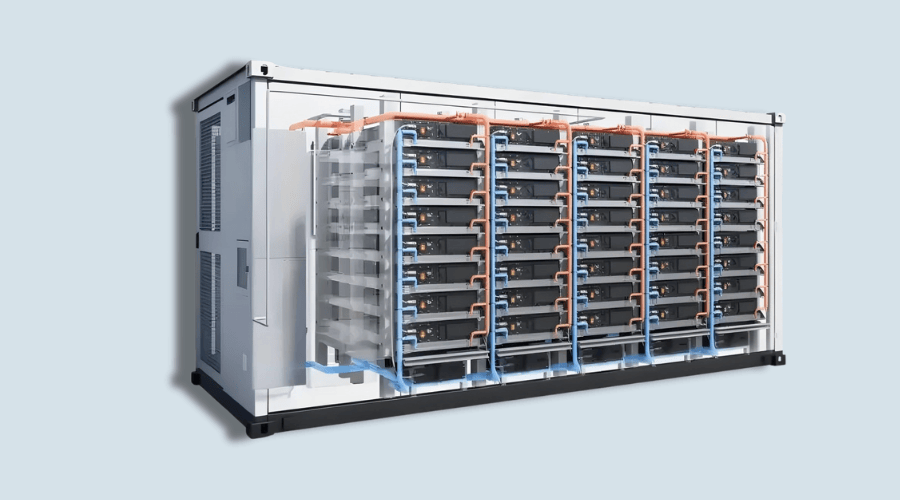
Amid the global energy transition, energy storage technology has become the “stabilizer” of renewable energy development. However, as energy storage systems continue to scale up, issues such as battery thermal runaway and lifespan degradation occur frequently, becoming key bottlenecks for industry growth. The thermal management system—seemingly an “invisible” technology—is in fact the “safety guardian” and “lifetime manager” of energy storage stations. How does it address high-temperature fire risks or low-temperature shutdowns? How does it make energy storage systems more efficient and longer-lasting? This article explores
energy storage thermal management systems from three perspectives—
What, Why, and How.
What: What Is an Energy Storage Thermal Management System?
1. Definition and Core Functions
An energy storage thermal management system is an intelligent system that monitors, regulates, and protects energy storage equipment (such as battery packs) through technologies including heat conduction, phase change materials, and intelligent algorithms. Its core objectives are:
-Temperature control: Keep battery temperature within the ideal range of 15–35℃ to prevent overheating or overcooling.
-Temperature uniformity: Minimize temperature differences between cells (typically ≤3℃) to prevent local hotspots that may trigger thermal runaway.
-Protection: Maintain system stability under extreme conditions, such as -30℃ cold or high-temperature exposure.
2. System Components
A complete thermal management system typically includes:
-Sensors: Monitor battery temperature, humidity, and other parameters in real time.
-Heat exchange devices: Air-cooled or liquid-cooled units, phase change material (PCM) layers.
-Control unit: Dynamically adjusts operating strategies using PID algorithms or AI models.
Why: Why Is Thermal Management Critical for Battery Storage Systems?
1. Safety Defense:
Prevent the “Invisible Killer” of Thermal Runaway
Over the past decade, more than 90 energy storage safety incidents have occurred worldwide, over 70% of which were directly related to battery thermal runaway. Thermal management systems can reduce the risk of thermal runaway by more than 90% through precise heat dissipation and early warning mechanisms. For example, a power station using liquid cooling experienced a 76% reduction in annual fault occurrences.
2. Lifespan Assurance:
Solve the “Temperature Difference Barrel Effect”
Every 5℃ increase in temperature difference between battery cells reduces cycle life by 15%. By using uniform temperature design (such as CATL’s zoned liquid cooling pipes), thermal management systems can compress the temperature difference to within 2℃, allowing system lifespans to exceed 12,000 cycles.
3. Performance Optimization:
“Breaking the Ice” in Low-Temperature Environments
In extreme cold conditions of -25℃, conventional air-cooled systems see efficiency drop sharply. A combined solution of phase change materials and electric heating can maintain battery discharge efficiency above 85%, helping northern solar-storage projects reduce curtailment by 40%.
4. Economic Benefits:
From “Energy Hog” to “Energy Hub”
Waste heat recovery technology can convert excess heat into heating energy, reducing overall energy consumption by 20%. In a German industrial park, this technology allowed an energy storage station to save over €500,000 annually in gas costs.
How: How Does a Thermal Management System Work in Battery Energy Storage Systems?
1. Core Technologies: From “Passive Cooling” to “Active Control”
-Air cooling: Low cost, simple structure, but low efficiency (suitable only for small-scale energy storage projects).
-Liquid cooling: Coolant (e.g., ethylene glycol solution) circulates through cold plates; thermal conductivity is 25 times that of air, making it the mainstream choice for large-scale energy storage.
-Phase change materials (PCM): Absorb or release latent heat during phase change, maintaining temperature stability (e.g., vanadium flow batteries with wide temperature ranges).
Intelligent algorithms: AI predicts temperature trends and dynamically adjusts operating parameters, reducing manual intervention.
2. Scenario Adaptation: Customized Solutions
-High-altitude areas: Enhance heat dissipation design to prevent reduced thermal exchange efficiency due to thin air.
-Coastal regions: Use corrosion-resistant materials to cope with high humidity.
-Extreme cold: Add antifreeze or integrate electric heating modules to prevent pipeline freezing.
Conclusion
Energy storage thermal management systems are not only the “firewall” safeguarding safety but also the “lifeline” extending battery lifespan, and the “golden key” unlocking energy storage economic benefits. With the proliferation of liquid cooling technology and AI algorithm upgrades, thermal management systems are evolving from “functional accessories” to “core value creators.” In the future, thermal technology may play an even more critical role in new models such as virtual power plants and integrated solar-storage-charging systems.