Do refrigerant and coolant exchange heat in a thermal management system? And how is this heat exchange achieved?
First, the answer to the first question is yes.
Refrigerant and coolant need to exchange heat, and this can happen more than once in a thermal management system.
Why Do Refrigerant and Coolant Need to Exchange Heat?
1. Battery Cooling Mode
To keep the battery pack operating at a suitable temperature, during battery cooling, the refrigerant passes through the
battery chiller and removes heat from the coolant, thereby lowering the coolant temperature.
2. Indirect Heat Pump Heating Mode
In an indirect heat pump thermal management circuit, during heating mode, the refrigerant transfers its heat to the coolant through the
liquid-cooled condenser (LCC), raising the coolant temperature.
The heated coolant then passes through the heater core in the HVAC unit, providing the required heat.
From these two processes, it can be seen that heat exchange between the refrigerant and coolant is achieved through components such as the battery chiller and liquid-cooled condenser (LCC).
So, what exactly are these two components?
In fact, both battery chillers and liquid-cooled condensers can use a plate heat exchanger structure.
What Is a Plate Heat Exchanger?
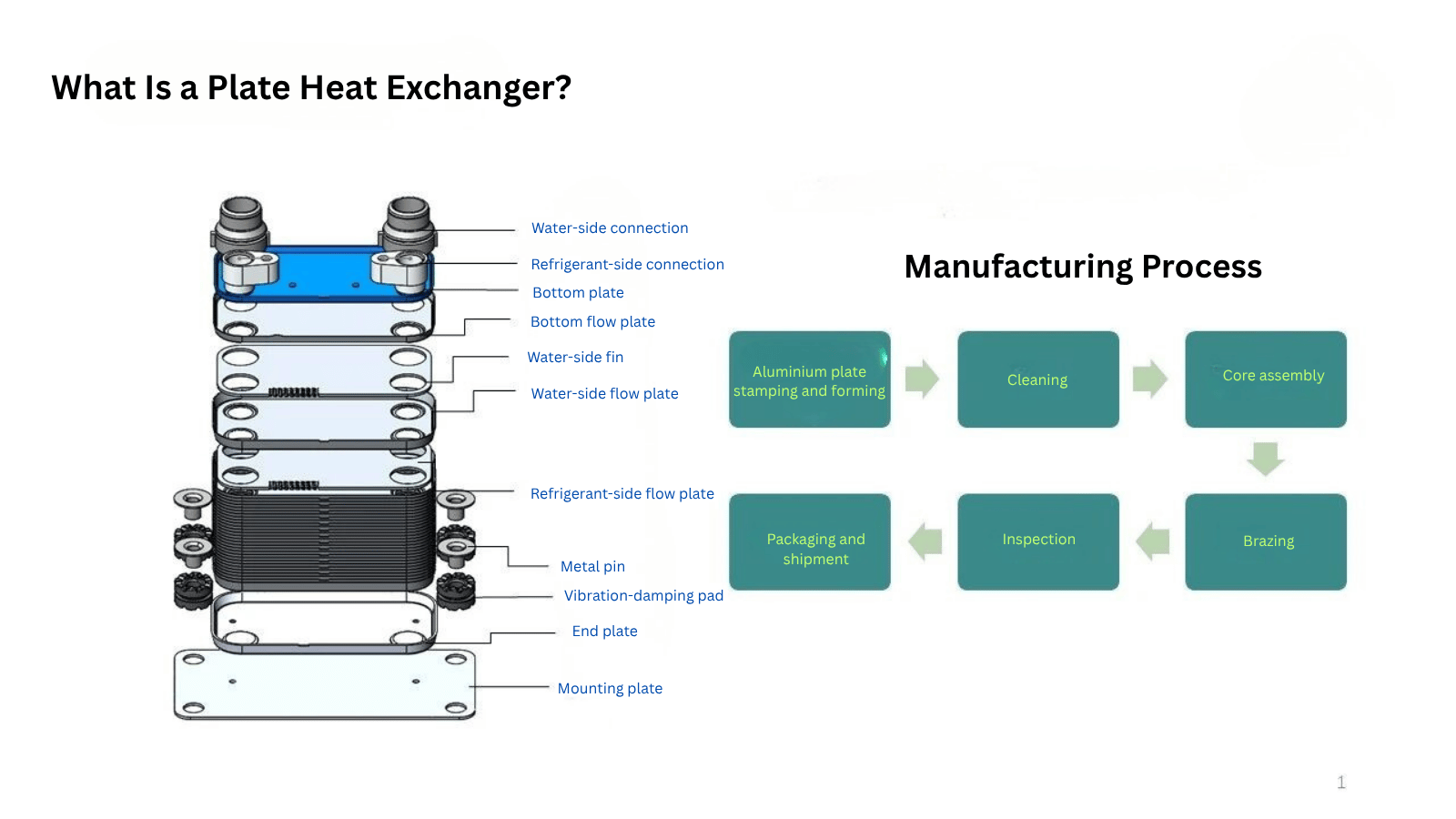
A plate heat exchanger is made up of multiple corrugated plates arranged at specific intervals and joined together through a brazing process.
The ports and flow channels on the stamped plates are used to distribute and collect the fluids, keeping the hot and cold fluids in separate flow channels. The plates act as the heat transfer surfaces through which heat is exchanged.
In simple terms, the refrigerant and coolant flow through their respective channels and exchange heat through the plates.
What Are the Main Characteristics of Plate Heat Exchangers?
The structure and heat transfer principle of a plate heat exchanger give it the following characteristics.
Advantages
Compact and lightweight structure
Small footprint
High heat transfer efficiency
Long service life
Wide range of applications
Low heat loss
Easy installation and cleaning
Limitations of Plate Heat Exchangers
1. Relatively limited capacity
Compared with shell-and-tube heat exchangers, plate heat exchangers generally have a relatively smaller capacity.
2. Relatively higher pressure loss
Because the flow channels between the heat transfer surfaces are relatively narrow and the plates have corrugated structures, pressure loss can be higher than with conventional smooth tubes.
3. Working pressure and temperature limitations
The allowable working pressure and medium temperature depend on the specific structure, materials and sealing method of the plate heat exchanger.
Flow Channel Designs of Plate Heat Exchangers
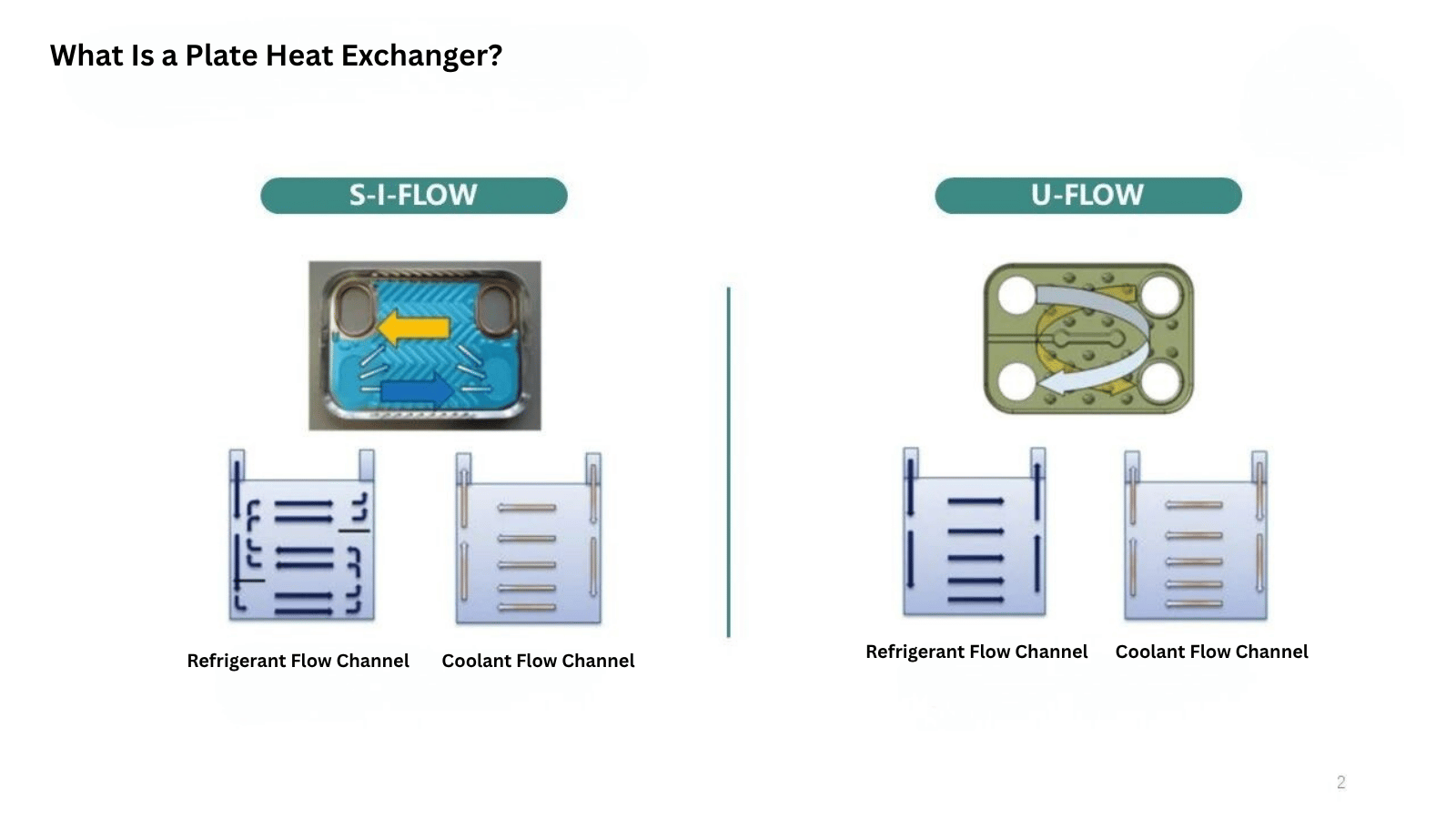
Depending on how the refrigerant and coolant flow channels are arranged, plate heat exchangers can use different flow channel designs, such as S-I-FLOW and U-FLOW.
S-I-FLOW
In S-I-FLOW, the refrigerant flows through an S-shaped path, while the coolant flow channels are similar to those of a condenser.
The vertical channels on both sides function similarly to headers, while the channels formed in the stamped plates are similar to flat tubes.
U-FLOW
In U-FLOW, the refrigerant and coolant have similar flow channel arrangements, both of which are similar to those used in a condenser, but the flow directions of the two fluids are opposite.
Conclusion
Chillers and liquid-cooled condensers (LCCs) are important components in
thermal management systems, helping achieve efficient heat exchange between refrigerant and coolant.