As construction machinery transitions to electric power,
thermal management has become a core technology—directly impacting machine performance, reliability, and operating costs. Compared with fuel-powered equipment, electric construction machinery faces more complex thermal demands and harsher operating conditions. This article examines the technical differences, core challenges, and practical solutions.
1. Fuel vs. Electric: Generational Differences
1.1 Fuel Systems: Mechanically Driven, Distributed Architecture
Thermal management in fuel-powered construction machinery centers on engine cooling, with separate circuits for hydraulics and the cab. Mechanical water pumps, radiators, thermostats, and fans handle heat rejection. The circuits operate independently with no coupling or energy exchange. Control is mechanical—response is slow and accuracy limited.
This architecture is simple, cost-effective, and reliable. However, it suffers from high parasitic losses, poor temperature control precision, limited extreme-condition performance, and low overall efficiency.
1.2 Electric Systems: Electronically Controlled, Integrated Architecture
Electric and hybrid machines use a multi-loop, strongly coupled architecture consisting of a cab HVAC loop, a high-temperature loop (motors, power electronics, hydraulics), and a low-temperature loop (battery). Multi-way valves and intelligent algorithms allocate heat across loops as operating conditions change.
This architecture enables precise temperature control and energy cascade utilization—for example, recovering drive-system waste heat for battery preheating or cab heating. However, system complexity, development difficulty, and manufacturing costs are significantly higher.
2. Lessons from Passenger and Commercial Vehicles
2.1 Passenger Vehicles: Source of Innovation
Passenger EVs lead thermal management innovation, having progressed from distributed to integrated to heat pump-based architectures. Their experience in compact packaging, heat pump systems, and intelligent algorithms provides useful references for construction machinery.
2.2 Commercial Vehicles: Direct Reference
Commercial vehicles (trucks and buses) carry heavier loads and require greater cooling capacity, especially fuel-cell models. Their thermal management prioritizes uptime, TCO, and reliability, with clear requirements for high-power heat dissipation and durability. As the closest product category to construction machinery, commercial vehicles offer more directly applicable experience in system architecture, component selection, and control strategy development.
2.3 Construction Machinery: The Most Extreme Conditions
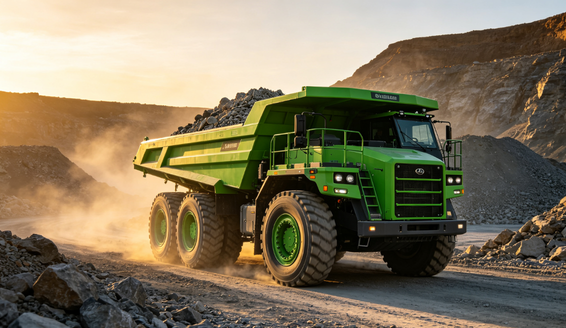
Construction machinery can be regarded as "extreme commercial vehicles." Its distinct characteristics include:
Harsher environments: high dust, strong vibration, wide temperature range (-35°C to 65°C), requiring higher protection levels and reliability than automotive standards;
Severe load fluctuations: continuous heavy loads, high power output, frequent starts and stops, demanding greater cooling capacity and dynamic response;
Different management priorities: sustained operability and machine availability take precedence over range or comfort;
Higher cost sensitivity: greater focus on ROI and life-cycle cost.
3. Three Core Challenges
The core challenges of thermal management for new-energy construction machinery center on three fronts: system complexity, extreme environmental adaptability, and energy-cost balance.
3.1 System Complexity
Managing multiple thermal targets simultaneously—batteries, motors, power electronics, hydraulics, and cab—each with different optimal temperature windows (batteries: 20-35°C, motors/electronics: 65-80°C, hydraulic oil: 40-60°C)—makes system architecture highly complex.
3.2 Extreme Environmental Adaptability
Construction machinery operates across a -35°C to 65°C temperature range, in high-dust and high-vibration environments. Thermal systems must maintain performance and reliability under these extreme conditions—a requirement that goes well beyond automotive standards.
3.3 Energy-Cost Balance
Thermal management systems themselves consume significant power (PTC heating,
compressor cooling). Energy efficiency must be optimized without compromising thermal safety. At the same time, the higher initial investment of new-energy systems must be justified through operating cost savings, requiring careful balancing of performance and cost.
4. Three Solutions: GUCHEN's Technology Roadmap
GUCHEN addresses these three challenges through a focused technology roadmap:
4.1 System Integration
Thermal design proceeds in parallel with machine development, integrating spatial layout, weight distribution, and energy management;
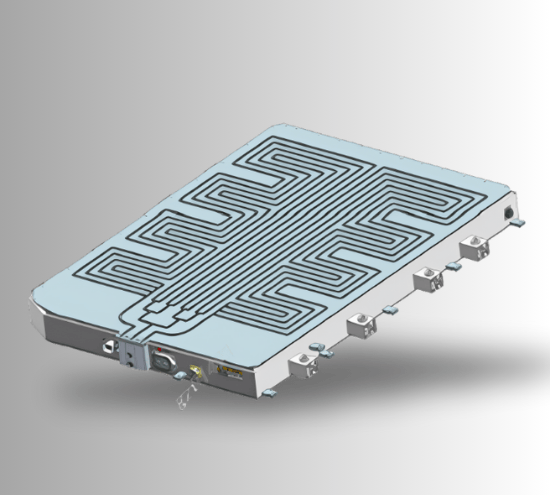
Modular integration of pumps, valves, and piping reduces leak points and improves reliability;
Thermal loops for battery, drive, hydraulics, and HVAC are interconnected for global energy optimization.
4.2 Intelligent Control
Predictive control based on digital twins, using real-time data for parameter adjustment;
Multivariable control algorithms (e.g., MPC) for coordinated multi-actuator operation;
Machine learning enables adaptation to varying conditions and component aging, reducing manual calibration.
4.3 Core Components
Development of
thermal management core components:
Efficient, compact, high-reliability design with vibration resistance and wide temperature tolerance;
Designed for mines, tunnels, severe cold, and extreme heat;
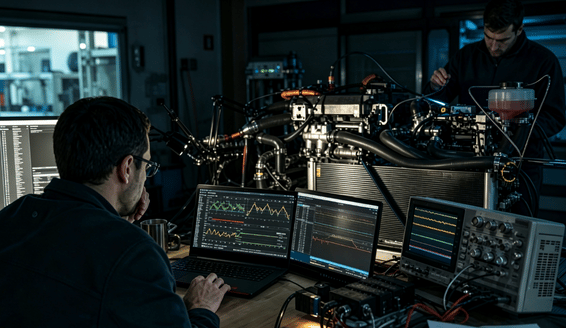
Validated through engineering testing to ensure reliability under real-world operating conditions.
Conclusion
Thermal management is a critical technology for electric construction machinery, directly affecting machine availability, operating costs, and lifecycle value.
GUCHEN provides
integrated thermal management solutions for electric construction machinery, supporting customers in system development and performance optimization.
As thermal management technologies continue to advance, electric construction machinery will achieve higher reliability, improved operational efficiency, and better lifecycle economics—driving the industry toward a greener and more sustainable future.