1. What Is a Battery Chiller?
A battery chiller, also called a battery water-to-refrigerant heat exchanger, is a key part of a battery thermal management system. Its main job is to remove heat from the battery pack and help keep the battery at a safe and efficient operating temperature.
Its working principle is similar to that of a home air conditioner or refrigerator. Through the refrigerant phase-change cycle, it transfers heat from the battery coolant to the outside environment. In this way, the battery can stay within an ideal temperature range for performance, safety, and service life.
2. Main Types and Working Principles of Battery Chillers
According to the cooling medium, there are two mainstream active cooling solutions used in battery thermal management systems:
• Liquid-Cooling Battery Chiller
• Direct-Cooling Battery Chiller
2.1 Liquid-Cooling Battery Chiller
Liquid cooling is currently the most efficient and widely used technology in electric vehicles and large energy storage systems.
In this system, the battery chiller cools a separate coolant loop. The cooled coolant then circulates through the battery cooling plate and absorbs heat generated by the battery cells.
System Components
Compressor
The “heart” of the system. It compresses the refrigerant into a high-temperature, high-pressure gas and drives the refrigeration cycle.
Condenser
Installed at the front of the vehicle or in a system ventilation area. It releases heat from the refrigerant to the surrounding environment and condenses it into a high-pressure liquid.
Chiller
The core heat exchange component between the refrigerant and battery coolant. The refrigerant evaporates inside the chiller and absorbs heat from the battery coolant flowing through it.
Expansion Valve
The expansion valve reduces the pressure and temperature of the refrigerant before it enters the evaporator.
Battery Liquid Cooling Plate
A pipe or plate component in direct or indirect contact with battery cells. The cooled coolant flows inside and absorbs battery heat.
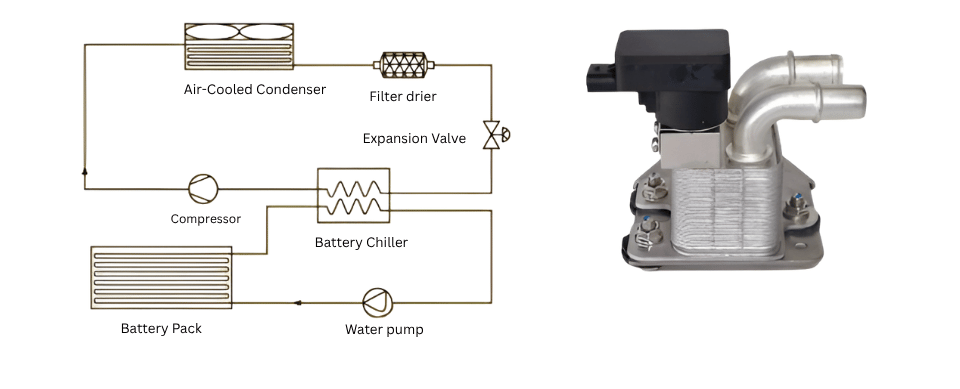
Working Process
The refrigerant absorbs heat from the battery coolant in the evaporator (chiller) and evaporates into a low-temperature, low-pressure gas.
The low-temperature gas is sucked into the compressor and compressed into a high-temperature, high-pressure gas.
The high-temperature, high-pressure gas enters the condenser, where it releases heat to the surrounding air and condenses into a high-pressure liquid.
The high-pressure liquid passes through the expansion valve, becomes a low-temperature, low-pressure mixture, and enters the evaporator again to repeat the cycle.
Meanwhile, the cooled battery coolant circulates through the battery liquid cooling plate via the water pump, continuously removing heat from the battery pack and returning to the chiller to transfer heat to the refrigerant.
Advantages
High cooling efficiency.
Uniform heat dissipation.
Strong temperature control capability.
Suitable for high-power charging and discharging scenarios.
Disadvantages
More complex system structure.
Higher system cost.
Heavier weight due to additional coolant components.
2.2 Direct-Cooling Battery Chiller
Direct cooling can be considered a simplified version of the liquid-cooling solution. In this design, refrigerant is used directly to cool the battery.
Unlike the liquid-cooling system, direct cooling removes the intermediate coolant loop. The refrigerant leaves the air-conditioning system and enters the evaporator or cooling plate integrated inside the battery pack, where it absorbs heat generated by the battery cells directly.
System Structure
The system structure is similar to the liquid-cooling solution, but the coolant loop, water pump, and related piping are removed.
Working Process
The refrigerant leaves the air-conditioning system and directly enters the evaporator integrated inside the battery pack.
After entering the evaporator, the refrigerant evaporates and directly absorbs the heat generated by the battery.
Without the intermediate coolant loop, the heat transfer path becomes shorter, improving overall heat exchange efficiency.
Advantages
Fewer components.
Lighter weight.
More compact structure.
Higher heat exchange efficiency due to fewer intermediate steps.
Disadvantages
More complex system control.
Refrigerant piping inside the battery pack increases leakage risk.
More difficult maintenance.
3. Key Benefits of Battery Chillers in Thermal Management
Battery temperature directly affects battery performance, safety, and service life.
During charging, discharging, and high-load operation, battery cells generate a large amount of heat. If the temperature becomes too high, charging power may decrease, power output may be limited, and battery aging may accelerate.
A battery chiller provides active cooling by efficiently transferring heat from the battery coolant loop to the refrigerant circuit, helping the battery maintain stable operation under different working conditions.
Precise Temperature Control
A battery chiller helps maintain battery temperature within the optimal operating range. Stable temperature control ensures consistent battery performance under different environmental conditions.
Improved Fast-Charging Performance
During DC fast charging, batteries generate significant heat due to high current input. Strong cooling capacity is essential to prevent charging power reduction caused by overheating.
A battery chiller helps maintain high charging performance while reducing thermal stress on the battery.
Battery Safety
A battery chiller provides active and forced cooling to reduce the risk of battery overheating. By controlling battery temperature within a safe range, it helps reduce the possibility of thermal runaway and improves overall system safety.
Extended Battery Service Life
Maintaining a stable operating temperature helps reduce battery degradation. A suitable thermal environment can slow down chemical aging inside battery cells and extend battery service life.
Stable Performance Output
During high-load operation, such as aggressive driving or heavy-duty applications, a battery chiller helps prevent power limitation caused by excessive battery temperature.
4. Main Application Scenarios of Battery Chillers
Battery chillers are widely used in applications where batteries require high performance, long operating hours, and reliable thermal control.
Electric Vehicles
Battery chillers are commonly used in electric vehicles, especially high-performance battery electric vehicles and plug-in hybrid vehicles. They help maintain battery temperature during fast charging, high-speed driving, and heavy-load operation.
Large Energy Storage Systems
Grid-level energy storage systems and commercial or industrial energy storage containers require long-duration and high-power operation. Efficient thermal management is essential to ensure system reliability and battery lifespan.
Electric Construction Machinery
Electric construction machinery, such as electric excavators, loaders, and other heavy-duty equipment, requires powerful thermal management solutions due to continuous high-load operation.
Electric Ships and Other High-Power Equipment
Battery chillers are also applied in electric ships, AGVs, and other high-power equipment where stable battery operation is required.
5.GUCHEN Battery Thermal Management Solution
With extensive experience in thermal management system development, GUCHEN provides high-performance battery thermal management components, including battery chillers and related heat exchange solutions.
Based on different application requirements, GUCHEN can also provide customized thermal management system solutions to help customers achieve efficient temperature control, reliable operation, and optimized system performance.
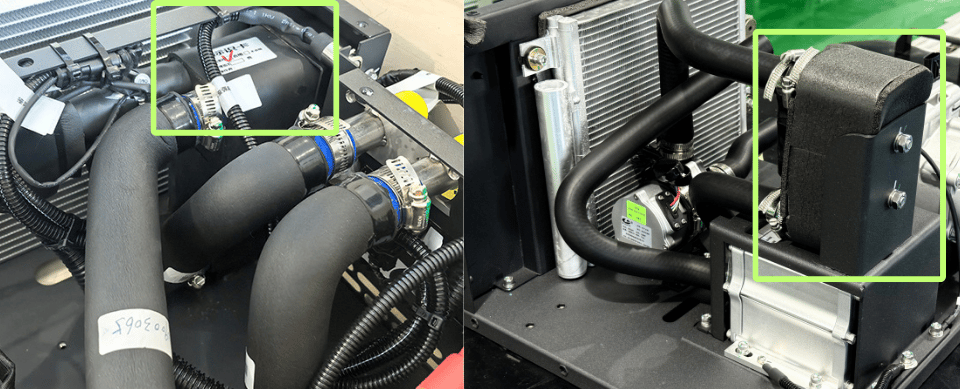
Guchen battery chiller applied in 8kW and 5kW EV thermal management systems