When people think of electric vehicle thermal management, they often picture one thing: the air conditioning system—cooling the cabin in summer and keeping it warm in winter.
But in today's electric passenger vehicles, thermal management is much more than cabin climate control. It has evolved into an intelligent system that regulates heat and energy throughout the entire vehicle.
Think of it as the vehicle's temperature control center. It keeps the battery, electric motor, power electronics, and other critical components operating within their ideal temperature range. At the same time, it helps improve driving range, vehicle safety, power performance, passenger comfort, and overall energy efficiency.
As EV technology continues to advance, thermal management has become a key area of competition among automakers. A more efficient system can reduce energy consumption, extend battery life, increase driving range, and even lower manufacturing costs through higher system integration.
In this article, we'll break down NEV thermal management in a simple and practical way. You'll learn:
• What thermal management actually controls in an electric vehicle
• How the system works behind the scenes
• Why integrated thermal management is becoming the industry standard
• How leading automakers are taking different approaches to thermal management
1.What Does Thermal Management Actually Control?
Unlike conventional gasoline vehicles, where thermal management mainly focuses on engine cooling and cabin air conditioning, thermal management in new energy vehicles covers the entire vehicle. Its job is to keep every key system operating within the right temperature range.
A modern NEV thermal management system is responsible for
four major areas:
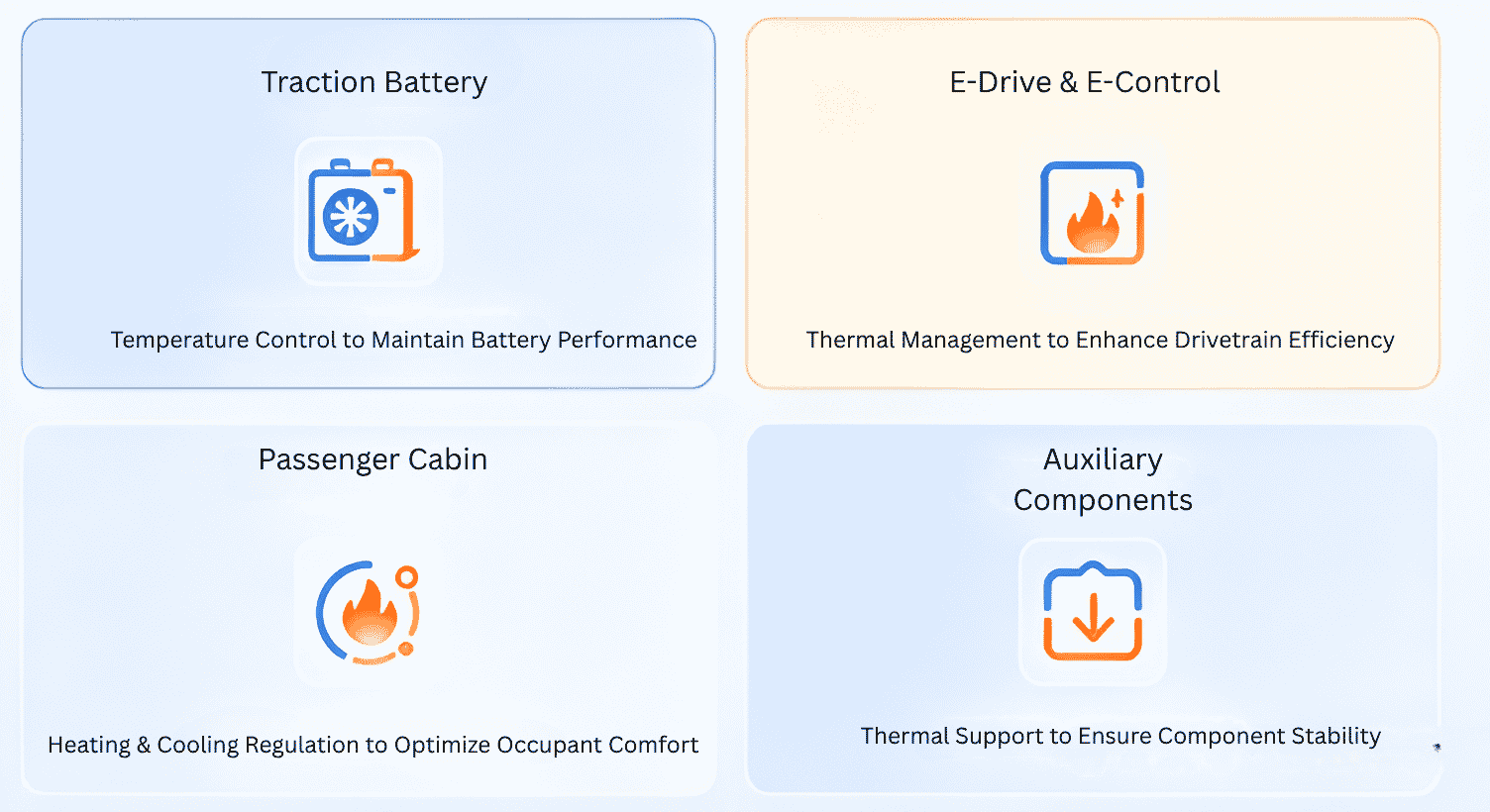
1.1 Traction Battery — The Highest Priority
The traction battery is the heart of every battery electric vehicle (BEV) and range-extended electric vehicle (REEV). It is also the component most sensitive to temperature.
Battery temperature directly affects:
• Safety
• Service life
• Charging efficiency
• Driving range
Different temperature conditions bring different challenges:
• High temperatures: Increase the risk of thermal runaway, potentially leading to battery fires.
• Low temperatures: Reduce electrolyte activity, resulting in shorter driving range and slower charging.
• Uneven cell temperatures: Large temperature differences within the battery pack accelerate battery aging and shorten its lifespan.
1.2. Electric Drive and High-Voltage Electronics
This category includes the traction motor, motor control unit (MCU), onboard charger (OBC), DC/DC converter, power distribution unit (PDU), and other high-voltage electrical components.
These components continuously generate heat during both driving and charging. Without effective cooling, excessive temperatures can lead to:
• Power derating
• Reduced vehicle performance
• Faster component aging
• High-voltage system failures in severe cases
1.3 Passenger Cabin
This is the part of the thermal management system that occupants experience most directly.
It is responsible for functions such as:
• Cabin cooling and heating
• Windshield defrosting and defogging
• Heated and ventilated seats
• Heated steering wheel
Besides improving comfort, features like defrosting and defogging are essential for maintaining clear visibility and safe driving.
1.4 Auxiliary Components
Thermal management also protects many smaller but equally important components throughout the vehicle, including:
• High-voltage wiring harnesses
• Charging connectors
• Brake system components
• Electronic valves and actuators
Keeping these components within their proper operating temperature range helps reduce failures caused by extreme heat or cold, ensuring reliable vehicle operation in all weather conditions.
2. Core Functions of Thermal Management: More Than Cabin Climate Control
Modern thermal management systems
do much more than keep the cabin comfortable. They continuously regulate temperatures across the vehicle to improve safety, efficiency, performance, and energy utilization.
2.1 Battery Thermal Control — The Top Priority
Battery thermal management is the most critical function in an electric vehicle.
Its responsibilities include:
•
Cooling: During fast charging, high-speed driving, hill climbing, or hot summer conditions, the system quickly removes excess heat to prevent thermal runaway.
•
Heating: In cold weather, it preheats the battery to improve cell activity, enabling faster charging and stronger power output.
•
Temperature Balancing: It keeps temperature differences between battery cells within approximately 2°C, helping slow battery aging and extend service life.
•
Heat Retention: While the vehicle is parked, the system minimizes heat loss to reduce energy consumption during the next startup.
2.2 Thermal Protection for the Electric Drive System
The thermal management system continuously cools key high-voltage components, including the electric motor, power electronics, and onboard charger.
In cold environments, it also preheats these components to ensure stable power delivery. Proper temperature control helps prevent power derating, performance loss, and premature component wear.
2.3 Passenger Cabin Climate Control
Thermal management also delivers a comfortable driving experience throughout the year by automatically adjusting cabin temperature.
Typical functions include:
• Cabin cooling and heating
• Windshield defrosting and defogging
• Seat heating and ventilation
• Heated steering wheel
Beyond comfort, features such as defrosting and defogging play an important role in maintaining driving safety.
2.4 Waste Heat Recovery — A Unique Advantage of Electric Vehicles
One of the biggest advantages of EV thermal management is its ability to recover and reuse waste heat.
Instead of allowing heat generated by the battery, electric motor, and power electronics to dissipate, the system redirects it to warm the passenger cabin or preheat the battery. This reduces reliance on energy-intensive PTC heaters, lowers overall energy consumption, and can increase winter driving range by
10–15%.
2.5 Vehicle-Wide Safety Protection
A modern thermal management system is designed to perform reliably under a wide range of operating conditions, including:
• Extreme cold
• High ambient temperatures
• High-speed driving
• Fast charging
• Vehicle parking
• Hill climbing
Combined with over-temperature monitoring, automatic power limiting, and fault protection strategies, thermal management helps safeguard high-voltage components while ensuring the overall safety and reliability of the vehicle.
3. Integrated Thermal Management: The Industry's Shift from Standalone Systems to Smart Integration
As electric vehicles continue to evolve, thermal management systems are undergoing a major transformation. Instead of using separate cooling circuits for different vehicle systems, automakers are increasingly adopting Integrated Thermal Management Systems (ITMS
) that coordinate heat flow across the entire vehicle.
3.1 Traditional Distributed Thermal Management
Early-generation and entry-level EVs typically used a distributed thermal management architecture.
In this design, the battery, electric drive system, and passenger cabin each have their own independent cooling loop, complete with dedicated pumps, heat exchangers, piping, and valves.
While simple to implement, this approach has several disadvantages:
• More components and greater system complexity
• Increased vehicle weight
• Larger packaging space under the hood
• No heat sharing between systems
• Higher overall energy consumption
• More potential maintenance and failure points
3.2 What Is an Integrated Thermal Management System (ITMS)?
An Integrated Thermal Management System breaks down the barriers between individual thermal loops.
Instead of operating independently, components such as valves, heat exchangers, water pumps, and sensors are integrated into a centralized
thermal management module with shared coolant circuits and multi-way valve control.
A dedicated thermal management controller continuously monitors vehicle operating conditions and intelligently distributes heat where it is needed, automatically switching between cooling, heating, and waste heat recovery modes.
3.3 Key Benefits of Integrated Thermal Management
Compared with conventional distributed systems, ITMS offers several significant advantages.
Lower Energy Consumption and Longer Driving Range
By recovering and reusing waste heat more efficiently, heat utilization can increase by more than
30%, while winter driving range may improve by
10–20%.
Lighter Weight and Better Packaging
Integrated designs reduce the number of pipes, valves, and other components, saving valuable installation space and supporting more compact EV platforms.
Improved Reliability and Safety
Fewer coolant connections reduce the risk of leakage, while more precise temperature control helps improve system reliability and protect critical components.
Better Performance in All Driving Conditions
One integrated system can intelligently adapt to a wide range of operating environments—from freezing winters to extremely hot summers—ensuring stable vehicle performance under all conditions.
3.4 Three Levels of Thermal Management Integration
Depending on the level of integration, today's thermal management systems generally fall into three categories.
Partial Integration (Entry-Level)
Only components within a single subsystem are integrated, while the battery, electric drive, and cabin thermal loops remain independent.
This solution offers the lowest cost and is commonly used in entry-level electric vehicles.
Regional Integration (Mainstream)
The battery and electric drive systems share a common thermal loop, allowing waste heat from the motor to preheat the battery, while the cabin maintains a separate climate control circuit.
This architecture provides an excellent balance between performance and cost, making it the most widely adopted solution in mid-range EVs.
Full Integration (Premium)
The battery, electric drive, and passenger cabin are all connected through a unified thermal management system.
By combining coolant circuits, refrigerant circuits, and high-efficiency heat pump technology, full integration maximizes energy utilization and represents the preferred solution for today's premium electric vehicles.
4. How Leading EV Manufacturers Approach Thermal Management
As thermal management technology continues to evolve, automakers have adopted different system architectures based on their vehicle platforms, cost targets, and performance priorities. While the ultimate goal is the same—improving efficiency, safety, and driving range—the technical approaches vary significantly.
Tesla | Refrigerant-Centric Full Integration
Tesla is widely regarded as one of the industry's benchmarks for integrated thermal management.
Its system centers around a highly integrated refrigerant loop, featuring a proprietary heat pump manifold that combines the compressor, multi-way valves, and heat exchangers into a compact module.
The battery is heated and cooled directly through the refrigerant circuit, while a separate coolant loop manages the electric drive system.
Key advantages
Excellent heat pump performance in low temperatures
Stable operation even at
-10°C
Industry-leading waste heat recovery efficiency
Very low overall energy consumption
Representative models
• Model 3
• Model Y
• Cybertruck
BYD | Self-Developed Eight-in-One Integrated System
BYD has developed its own Eight-in-One Thermal Management System, integrating valves, electronic expansion valves, heat exchangers, water pumps, and other key components into a single module.
The battery uses direct cooling and heating, while the electric drive system adopts liquid cooling. Heating is primarily provided by a heat pump, with PTC heating used as supplemental support.
Key advantages
• High level of system integration
• Reduced coolant leakage risk
• Optimized for Blade Battery technology
• Strong low-temperature performance
• Scalable across vehicles in different price segments
Representative models
• Han EV
• Seal
• Dolphin
• Atto 3 (Yuan PLUS)
XPENG | Coolant-Based Regional Integration
XPENG focuses on a practical and cost-effective regional integration strategy.
Its battery and electric drive systems share coolant circuits through three-way and four-way valves, allowing waste heat to be reused efficiently. The passenger cabin remains independent and uses a heat pump assisted by a PTC heater.
Key advantages
• Mature and reliable technology
• Lower maintenance risk
• Balanced waste heat utilization
• Cost-effective system design
Representative models
• P7i
• G6
• G9
Li Auto | Dual Heat Pump System for Range-Extended EVs
Li Auto has developed a thermal management solution specifically for range-extended electric vehicles (REEVs).
The system combines waste heat from the range extender with battery and electric drive thermal management. Dual heat pumps independently serve the battery and passenger cabin, while engine waste heat provides additional heating in extremely cold weather, reducing reliance on PTC heaters.
Key advantages
Excellent performance in temperatures as low as
-25°C
Reduced winter range loss
Outstanding passenger comfort
Optimized for REEV applications
Representative models
• L7
• L8
• L9
• MEGA
Comparison of Mainstream Thermal Management Solutions
| Automaker |
Integration Level |
Core Technology |
Low-Temperature Performance |
Typical Applications |
| Tesla |
Full Integration |
Refrigerant manifold + direct battery cooling/heating |
★★★★★ |
Premium BEVs |
| BYD |
Full Integration |
Eight-in-One integrated module |
★★★★☆ |
Mass-market EVs |
| XPENG |
Regional Integration |
Shared coolant loops + multi-way valves |
★★★★☆ |
Mid-range BEVs |
| Li Auto |
Full Integration |
Dual heat pumps + range extender waste heat recovery |
★★★★★ |
Premium REEVs & BEVs |
Conclusion
Thermal management has become one of the most critical technologies in modern electric vehicles. Far beyond cabin air conditioning, it is an intelligent system that manages heat across the entire vehicle—helping improve safety, extend battery life, optimize energy efficiency, and deliver a better driving experience.
As EV technology continues to evolve, thermal management is shifting from standalone subsystems to highly integrated, intelligent architectures. Heat pumps, waste heat recovery, and integrated thermal management systems are already redefining vehicle efficiency today, while future innovations such as AI-driven thermal control and vehicle-wide energy management will further enhance EV performance and sustainability.
At GUCHEN, we are committed to advancing EV thermal management technology through reliable and efficient integrated solutions. From battery thermal management to complete vehicle thermal systems for passenger vehicles, commercial vehicles, and
battery energy storage systems, we help manufacturers improve system performance, energy efficiency, and long-term reliability.


.png)