Introduction
Unlike conventional internal combustion engine vehicles, electric vehicles do not have engine waste heat available for cabin heating. As a result, an independent heat source is required to maintain passenger comfort and support battery performance in cold environments.
PTC heaters have become one of the most important components in
EV thermal management systems. They are widely used for cabin heating and battery preheating, helping electric vehicles maintain reliable operation under low-temperature conditions.
What Is a PTC Heaters?
PTC stands for Positive Temperature Coefficient. It is a type of thermistor whose electrical resistance increases as temperature rises.
When electric current passes through the PTC element, heat is generated. As the temperature increases, resistance rises automatically, reducing current flow and lowering heating power. This self-regulating characteristic allows the heater to maintain a relatively stable operating temperature without overheating.
PTC heating elements are generally classified into two categories:
- Ceramic-based PTC thermistors.
- Polymer-based PTC thermistors.
Among them, ceramic PTC materials are commonly used in automotive applications because they offer stable heating performance, high thermal efficiency, long service life, and inherent safety.
Why Electric Vehicles Need PTC Heaters
Cabin heating
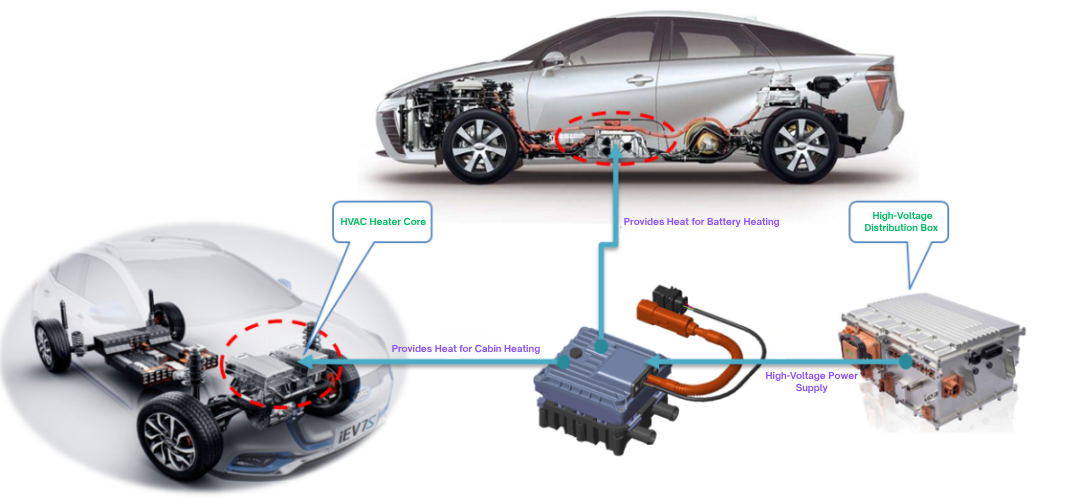
Traditional vehicles use waste heat from the engine cooling system to provide warm air for the passenger compartment. Since electric vehicles do not have an engine, they require an independent heating source. PTC heaters generate heat directly from electricity and supply warm air to the HVAC system.
Battery preheating
Battery performance decreases significantly at low temperatures. Reduced battery activity can negatively affect driving range, charging efficiency, and power output.
PTC heaters can warm the battery pack to a suitable operating temperature range, helping maintain battery performance and vehicle reliability in cold weather.
Types of PTC Heaters
Based on the heating medium, automotive PTC heaters are divided into two main types.
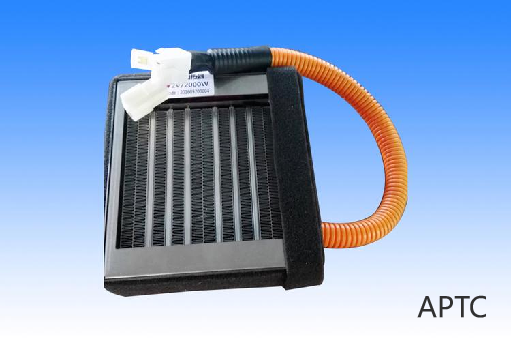
Air PTC heater
Air PTC heaters are installed directly inside the HVAC air duct. Cold air flows through the heating element and is heated before being delivered into the cabin by the blower.
Main features:
- Direct air heating.
- Fast temperature rise.
- Simple structure.
- Higher power consumption.
Typical components include:
- PTC heating element.
- High-voltage connector.
- Low-voltage connector.
- Temperature sensor.
- Controller.
Some designs integrate the controller, while others use an external control module.
Water PTC heater
Water PTC heaters heat coolant instead of air directly. The heated coolant flows through the HVAC heater core, where heat is transferred to the air before being distributed throughout the cabin.
Main features:
- Indirect heating through coolant.
- More uniform heat distribution.
- Better passenger comfort.
- Compatible with traditional HVAC architectures.
Water PTC systems have become the mainstream heating solution in modern electric vehicles.
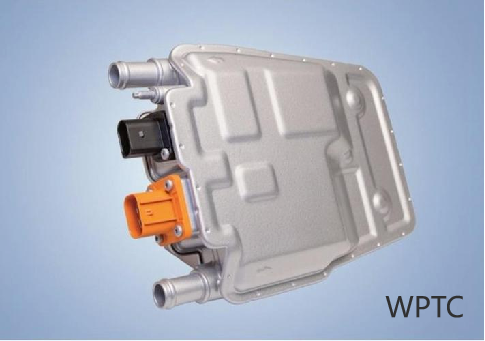
Typical external interfaces include:
- Coolant inlet.
- Coolant outlet.
- High-voltage connector.
- Low-voltage connector.
PTC Water Heating System Structure
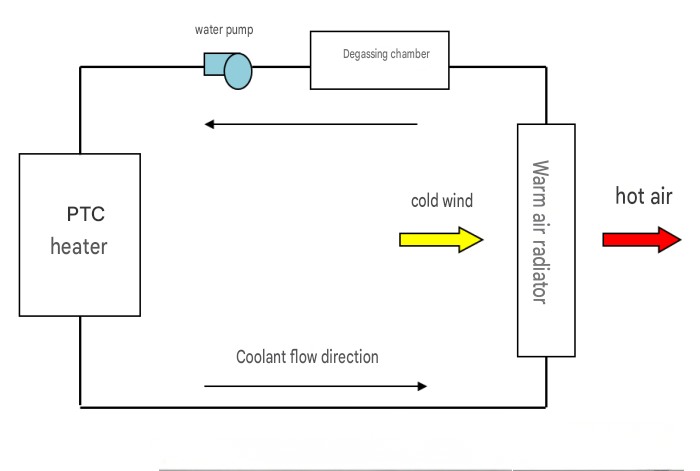
A typical PTC water heating system consists of:
- PTC water heater.
- Electric coolant pump.
- Degassing chamber.
- Coolant hoses.
- HVAC heater core.
► Functions of the degassing chamber
Pressure relief
Coolant may generate vapor during the heating process, causing system pressure to rise. When pressure exceeds a certain threshold, the vent valve opens automatically to release vapor and reduce system pressure.
Coolant compensation
The degassing chamber also stores coolant, allowing the system to compensate for coolant loss during operation.
How a PTC Water Heater Works
The operating process is straightforward:
1. The high-voltage battery supplies electrical power to the PTC heater.
2. The PTC element converts electrical energy into heat.
3. Coolant flows through the heater and absorbs heat.
4. The electric pump circulates the heated coolant.
5. Hot coolant enters the HVAC heater core.
6. The blower transfers heat into the passenger compartment.
7. The coolant returns to the heater and the cycle repeats continuously.
To improve efficiency and reduce battery energy consumption, temperature sensors are typically installed at the heater inlet, heater outlet, and cabin air locations. The controller continuously adjusts heating power based on temperature feedback.
PTC Control System Architecture
Whether using an air heater or a water heater, the controller architecture is generally similar.
A typical control system includes:
- High-voltage positive terminal.
- High-voltage negative terminal.
- 12V power supply.
- Ground connection.
- CAN communication line.
- LIN communication line.
- Interlock signal input.
- Interlock signal output.
The control unit receives commands through CAN or LIN communication networks. The ECU drives IGBT switching devices and regulates heating power through PWM control. Multiple PTC heating elements can be controlled independently to achieve different heating levels while monitoring current and temperature conditions.
Key Functions of Modern PTC Heating Systems
Soft start function
The heater starts at low power and gradually increases PWM duty cycle. This reduces inrush current, minimizes stress on electrical components, and helps extend battery life.
Wide voltage operation
Battery voltage varies as the state of charge changes. A high-performance PTC heater can maintain stable heating performance across a wide operating voltage range, such as DC400V to DC600V.
Linear power regulation
By adjusting PWM signals, the controller continuously regulates heating output according to cabin and coolant temperature feedback. This approach improves comfort while reducing energy consumption.
CAN-based diagnostics
The system can detect and report faults such as heater element failure, water pump malfunction, and CAN communication failure. When necessary, the controller disconnects the high-voltage circuit and stops heating operation.
Independent heating element protection
If one heating tube fails, only the affected section is isolated while the remaining heating elements continue operating, improving system reliability.
Advantages of PTC Heaters
Fast heating performance
PTC heaters can generate heat quickly and provide warm air shortly after startup.
Simple and reliable structure
The system design is relatively simple, resulting in high reliability and low maintenance requirements.
Self-regulating temperature control
As temperature rises, resistance increases automatically, helping prevent overheating.
High safety level
Even if airflow or coolant circulation is interrupted, the heater power decreases automatically, keeping the surface temperature near its Curie temperature and reducing safety risks.
Limitations of PTC Heaters
High energy consumption
PTC heating converts electrical energy directly into heat, resulting in considerable battery power consumption.
Reduced winter driving range
Long-term high-power operation can significantly impact vehicle range during cold-weather driving.
PTC vs. Heat Pump System
PTC Heater: Uses direct electric resistance heating with an energy efficiency ratio close to 1:1, meaning it converts electricity directly into heat. It provides stable heating performance even in low-temperature environments, but consumes relatively more energy.
Heat Pump Air Conditioner: Transfers heat from the ambient air rather than generating heat directly. It offers significantly higher energy efficiency and lower power consumption. However, its heating performance can decrease substantially in extremely cold weather, making PTC auxiliary heating necessary in such conditions.
| Comparison Item |
PTC Electric Heating |
Heat Pump Air Conditioning |
| Heating Principle |
Direct heat generation through electrical resistance |
Uses a compressor to transfer heat from ambient air |
| Energy Efficiency (COP) |
Approximately 1:1 (1 unit of electricity produces 1 unit of heat) |
Typically 1:2 to 1:3 (1 unit of electricity produces 2–3 units of heat) |
| Power Consumption |
High power consumption; significantly impacts driving range |
Lower power consumption; less impact on driving range |
| Low-Temperature Performance |
Stable heating even at -20°C |
Efficiency drops significantly below 0°C; performance declines in extreme cold |
| Heating Speed |
Rapid warm-up and quick hot air delivery |
Slower temperature rise and often requires preheating |
| System Complexity & Cost |
Simple structure and lower cost |
More complex system and higher cost |
| Maintenance Difficulty |
Low failure rate and lower maintenance cost |
maintenance cost
Compressor and refrigerant circuit increase maintenance complexity and cost |
| Typical Applications |
Extreme cold climates, battery preheating, auxiliary heating |
Daily winter operation and moderate cold-weather conditions |
Common EV Heating Configurations
PTC-only system
This configuration is commonly found in entry-level electric vehicles.
Advantages:
- Simple design.
- Lower cost.
Disadvantages:
- High winter energy consumption.
- Significant range reduction.
Heat pump plus PTC auxiliary heating
This configuration is widely adopted in modern mid-range and premium EVs.
Typical operation:
- Above moderate ambient temperatures, the heat pump provides most of the heating.
- At low temperatures, the PTC heater supplements the heat pump to ensure stable heating performance.
Future Development Trend
As low-temperature heat pump technology continues to improve, more electric vehicles are adopting heat pump systems to reduce energy consumption and extend winter driving range.
However, because heat pumps still face efficiency challenges under extremely cold conditions, PTC heaters remain an essential auxiliary heating solution and will continue to play an important role in EV thermal management systems.
Conclusion
PTC heaters are a critical component of electric vehicle thermal management systems. They provide reliable cabin heating and battery preheating through efficient electric heating technology.
Available in both air-heating and water-heating configurations, PTC heaters offer fast response, simple structure, self-regulating temperature control, and high safety performance. Although their energy consumption is relatively high, they remain indispensable for maintaining vehicle comfort and battery performance, particularly in cold-weather environments.
As EV thermal management technologies continue to evolve, the industry is increasingly moving toward heat pump systems supported by PTC auxiliary heating, combining energy efficiency with reliable low-temperature operation.